The developer wanted the panels to be the answer
In February 2026 Xtrata, the Arizona maker of the SABS panel wall system, sent me where things stood on a four-story Hyatt Studios extended-stay hotel in Georgetown, Texas, in Williamson County. The question came through my standing seat with the company, and it was a simple one on its face. The developer had an original general contractor's budget on an early schematic design set, and a capital model that needed hard cost well below it, with the panel system's savings already counted. Everyone wanted the same answer from me: the system closes the gap.
The people in it were a hotel developer with a brand prototype to build and capital to raise; Xtrata, which wanted its first hotel under a national brand and its first Texas project; the original general contractor, whose budget was the baseline everything got measured against; Hyatt, whose brand standard the building had to meet; and, from April, a San Antonio general contractor with a Texas trade network. LÏEF Development ran the general contractor's construction review and the coordination with that Texas contractor. Common Ground ran the feasibility study with Xtrata. The work was advisory and non-exclusive: estimates, cost analysis, construction review and coordination.
The developer's position was worse than the question let on. It had been in due diligence for well over a year, the hotel's market report had gotten worse in that time, and it had already cut its own fees close to nothing. The gap between the schematic budget and the target was 16.6 percent of the whole building. That is not a value-engineering gap. It is a different building or a different market, and the developer's process for closing it was to get a budget that hit the number.
What it needed was not the answer it asked for. It needed the question split in two. Can this hotel be built on the panel system for the number the model needs, which is a construction question that can be answered to the dollar. And can the owner fund it, which is a capital question that a cost estimate cannot answer. My job was the first one, done honestly enough that it would never be the reason the second one failed.
Price the question you can price
I spent my career as a general contractor and developer before this seat, and since early 2026 I had been pricing the SABS system against wood-frame comparables on a run of residential jobs. That work taught me one thing that governed everything here. The system is cheaper where it replaces framing, trusses and insulation, and it is neutral almost everywhere else. A hotel is mostly everywhere else: plumbing, HVAC, electrical, finishes, site work, elevators.
So before anyone sold the swap, I took the original budget apart line by line and asked what share of it the panels could physically touch. The lines the system replaces outright are rough carpentry labor and material, the prefabricated trusses and the insulation. The lines it partly replaces are plaster and wallboard, because the panel's coating does most of that work. Everything else stays.
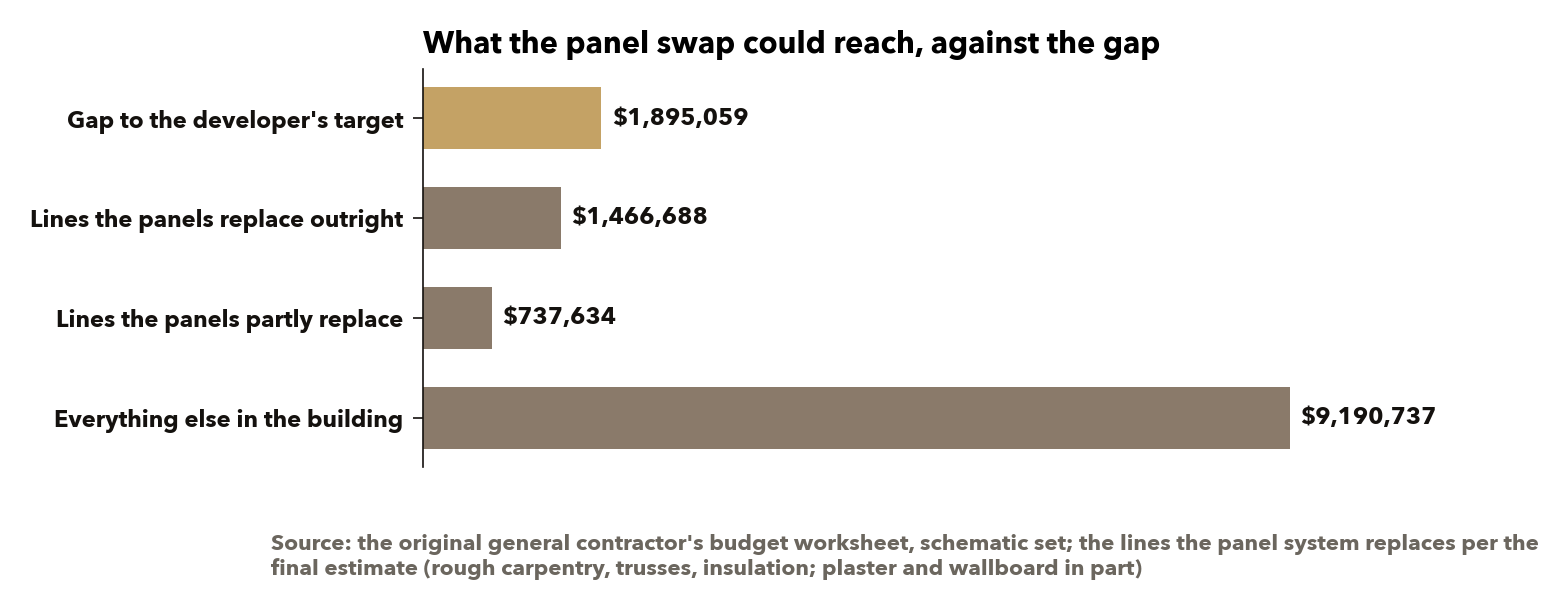
The arithmetic ends the argument. Even with the replaced lines at zero, the swap does not reach the gap, and the replaced lines are never zero, because the panel material comes back as its own cost. Counting labor savings on other trades, our February analysis put the realistic system impact at $400,000 to $800,000, which still left the budget $1 million to $1.5 million over target. On top of that, Texas had no trained SABS crews, no distributor and no inspectors who had seen the system, and conventional framing labor was cheaper there than in Arizona or California.
The easy move was to sell the swap anyway. Take the material savings on the structure, set them next to the old budget, and tell the developer the system gets them most of the way. The supplier wanted it, the developer needed it, and nobody in the room was going to push back. The other easy move was to walk away from Texas entirely. I did neither. I put it in writing that the swap alone could not close the gap, recommended that we not stretch the system to hit the number, and noted that the answer should be revisited if Hyatt Studios went national and volume changed the arithmetic. That answer cost something with people who wanted a yes. It also meant that when the facts changed two months later, the study could re-open on facts rather than hope.
How I came at this one
The first question was what share of this building a wall system can physically touch. It fit because a developer looking for one lever needs to see the size of the lever before anyone prices it, and the answer is arithmetic on a budget that already exists. The second question came in May, when a budget landed exactly on target: whose incentives produced that number, and what did they leave out to get there.